
Startups Should Not Build Remittance Apps
Because what they actually end up building is a global stablecoin neobank.
Every week we speak with founders who want to build a remittance product. Some are building creator platforms, others are launching marketplaces, global payroll tools, messaging apps, disbursement or community platforms that need to move money internationally. Eventually they all reach the same conclusion:
“We need global payments.”
So they begin researching how to build a remittance app or start looking for a white-label remittance solution. At first this sounds simple. Add a payments feature, integrate a provider, and launch.
But what most teams quickly discover is that global payments infrastructure is far more complex than expected. In fact, most startups trying to build a remittance app are actually trying to build something much bigger. They are trying to build a global stablecoin neobank.
Looking for a White-Label Remittance App?
Many founders start with the same search:
“Can we white-label a remittance app?”
The assumption is that instead of building a payments platform from scratch, they can license a prebuilt system and simply add their brand.
However, most white-label remittance platforms still require significant operational responsibility. Even with a provider, companies typically still need to manage:
• compliance and AML programs • identity verification (KYC) • banking integrations • payout partners across multiple countries • liquidity management • fraud monitoring and reporting
In practice, what is marketed as a white-label remittance app often still requires operating large parts of a financial institution. For startups building a creator platform, marketplace, or community product, this can become a major distraction from the core product they actually want to build.
Building a Remittance App Means Building a Neobank
Most founders start with a simple idea:
“We just want users to send money internationally.”
But once development begins, the scope expands quickly. Supporting global payments suddenly requires managing:
• user wallets • payment rails • on-ramps and off-ramps • card integrations • compliance systems • identity verification • settlement and liquidity
At this point the product stops looking like a simple remittance feature and begins to resemble a global financial platform.
In other words, teams realize they are building something closer to a global stablecoin neobank — a platform that stores value, moves money internationally, and connects to multiple financial networks.
Building that infrastructure from scratch is extremely difficult.
The Hidden Complexity of Global Payments
Traditional remittance systems rely on a patchwork of financial infrastructure. To move money across borders, companies typically need:
• correspondent banking relationships • foreign exchange settlement • regional payout providers • regulatory licensing • compliance monitoring systems
Launching and operating these systems can take years. Many startups underestimate how much time is spent building financial infrastructure instead of focusing on their actual product.
Stablecoins Changed the Equation
Over the past several years, stablecoins have introduced a fundamentally new model for global payments. Stablecoins allow value to move across blockchain networks instantly and globally without relying on traditional banking infrastructure.
This creates several advantages:
• near-instant settlement • global accessibility • lower transaction costs • programmable financial flows
Instead of transferring value through multiple correspondent banks, funds can move directly on-chain.
However, stablecoins alone do not solve the entire problem. To build real payment products, companies still need:
• on-ramps to convert fiat into digital assets • off-ramps to deliver funds in local currencies • payout networks such as bank transfers, cards, or cash pickup • compliance and identity verification infrastructure • messaging systems to notify recipients
This is where a new type of infrastructure is emerging.
Even Big Tech Is Exploring Stablecoin Payouts
Large technology companies are also exploring stablecoins as a solution for global payments. For example, Meta Platforms — the company behind Facebook, Instagram, and WhatsApp — has reportedly experimented with stablecoin payments across its platforms.
The goal is to enable faster and cheaper cross-border payments, including payouts to creators and businesses around the world.
For platforms with billions of users, stablecoins could dramatically improve:
• creator payouts • cross-border commerce • payments in emerging markets • global digital economies
This reflects a broader shift across the internet. Stablecoins are increasingly becoming a global settlement layer for digital platforms.
The Infrastructure Layer Behind Stablecoin Payments
As platforms experiment with stablecoin payments, a new type of infrastructure is emerging. Companies building global payment systems need far more than just a digital asset. They need the full stack required to move money internationally and deliver it to real users.
This includes:
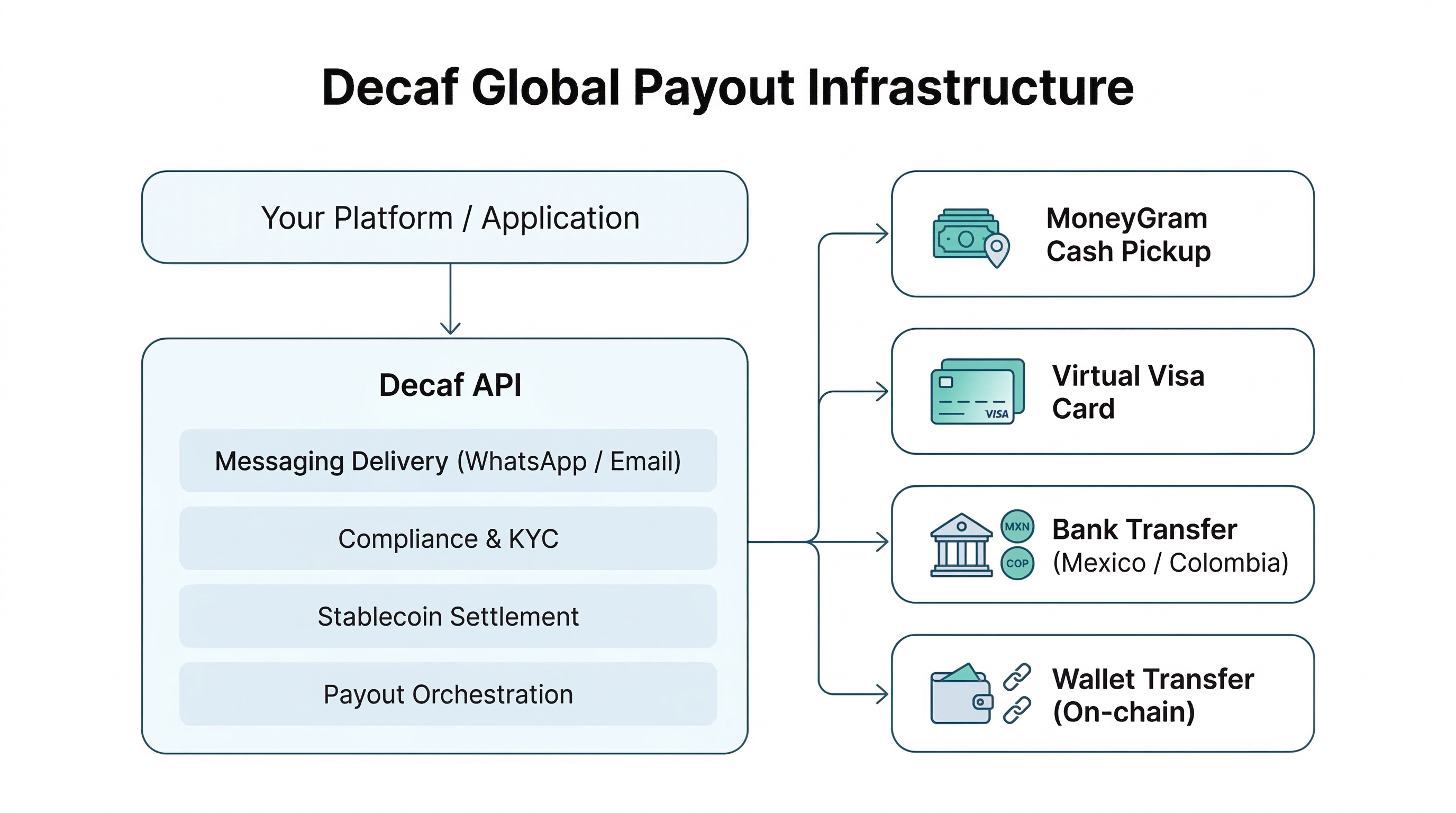
• stablecoin settlement on blockchain networks • fiat on-ramps and off-ramps • payout networks such as bank transfers, cards, and cash pickup • compliance and identity verification infrastructure • messaging systems to notify recipients
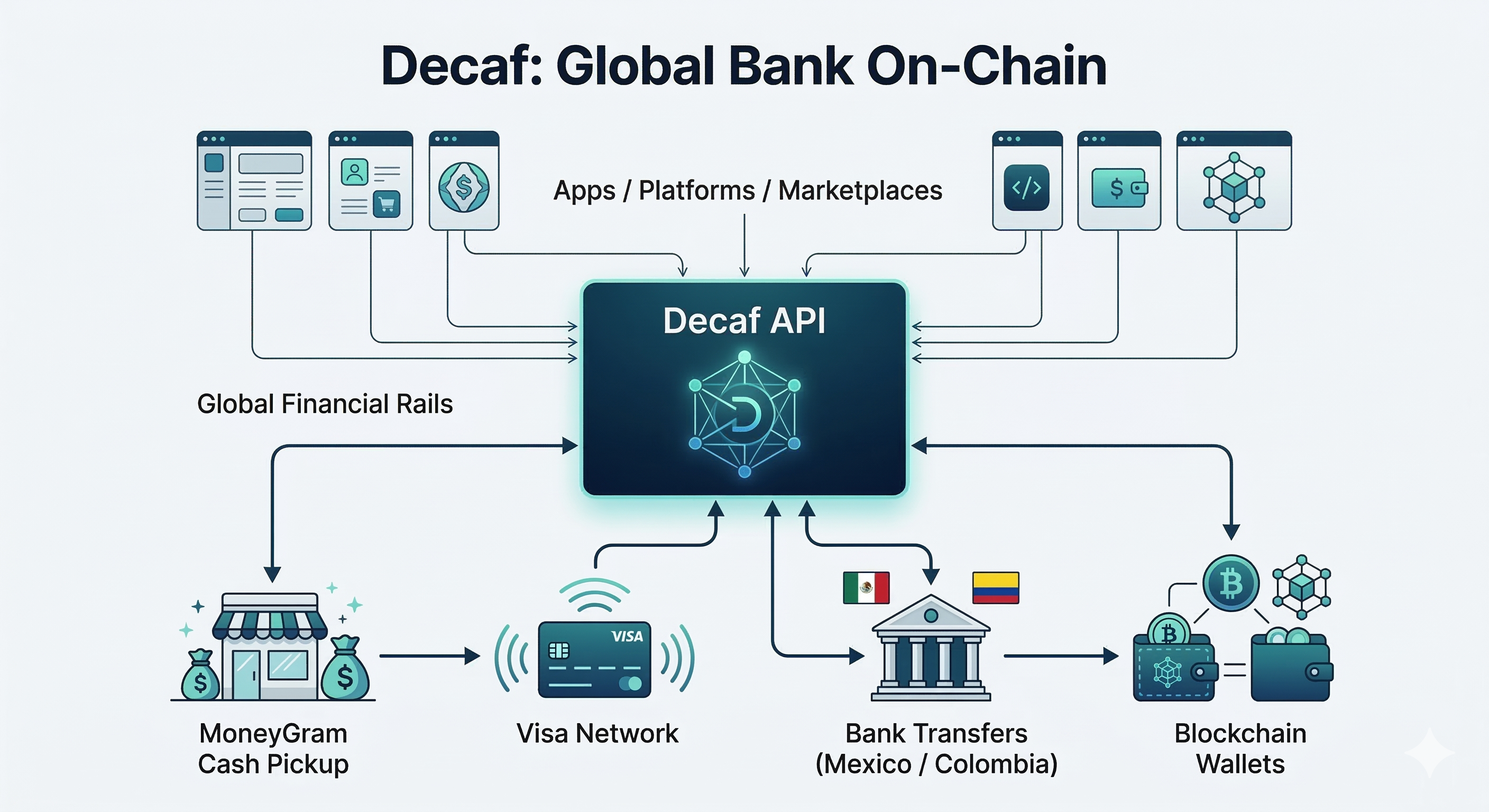
In practice, global stablecoin payments require a financial infrastructure layer that sits between applications and the underlying payment rails.
Platforms like Meta may experiment with stablecoin payouts at massive scale, but the systems that make these payments usable for real people are built by infrastructure providers.
What Is Global Stablecoin Payment Infrastructure?
Global stablecoin payment infrastructure is a software platform that allows companies to move money internationally using stablecoins and programmable APIs instead of traditional banking networks.
Instead of building a remittance company from scratch, platforms can integrate payment infrastructure that provides:
• stablecoin settlement on blockchain networks • global payout rails such as cash pickup, cards, and bank transfers • messaging-based delivery through channels like WhatsApp • compliance and identity verification infrastructure
This allows companies to build financial products without becoming financial institutions themselves.
Build Your Product, Not a Remittance Company
At Decaf, we believe most companies should not need to build a remittance platform to move money globally. Instead of launching a remittance product from scratch, platforms can integrate financial infrastructure directly into their own application.
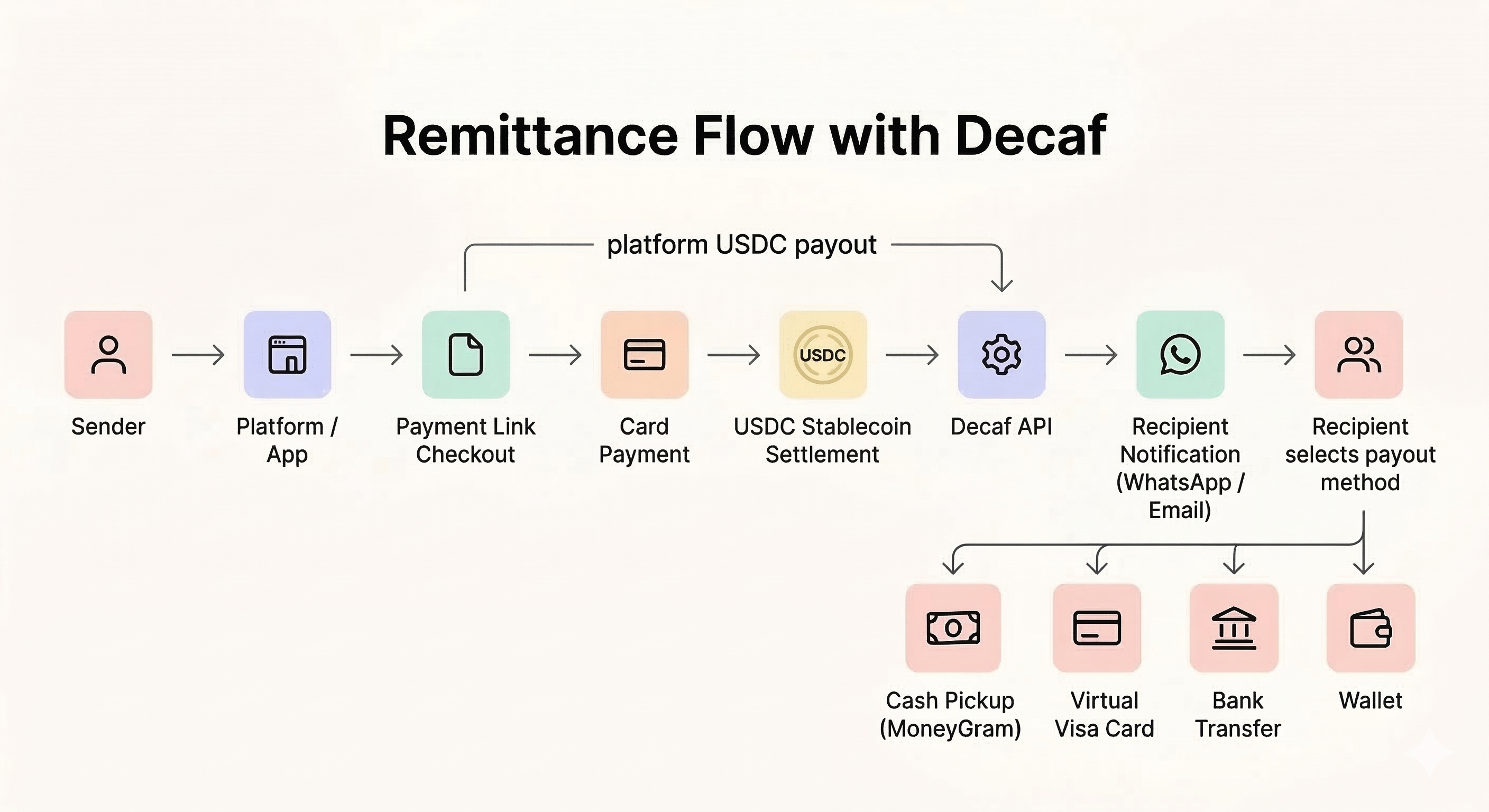
Using stablecoins and blockchain settlement, Decaf enables platforms to send funds globally while orchestrating real-world payout methods.
Recipients can receive funds through:
• cash pickup • virtual Visa cards • bank transfers • blockchain wallets
All from a single integration.
Messaging-Native Financial Services
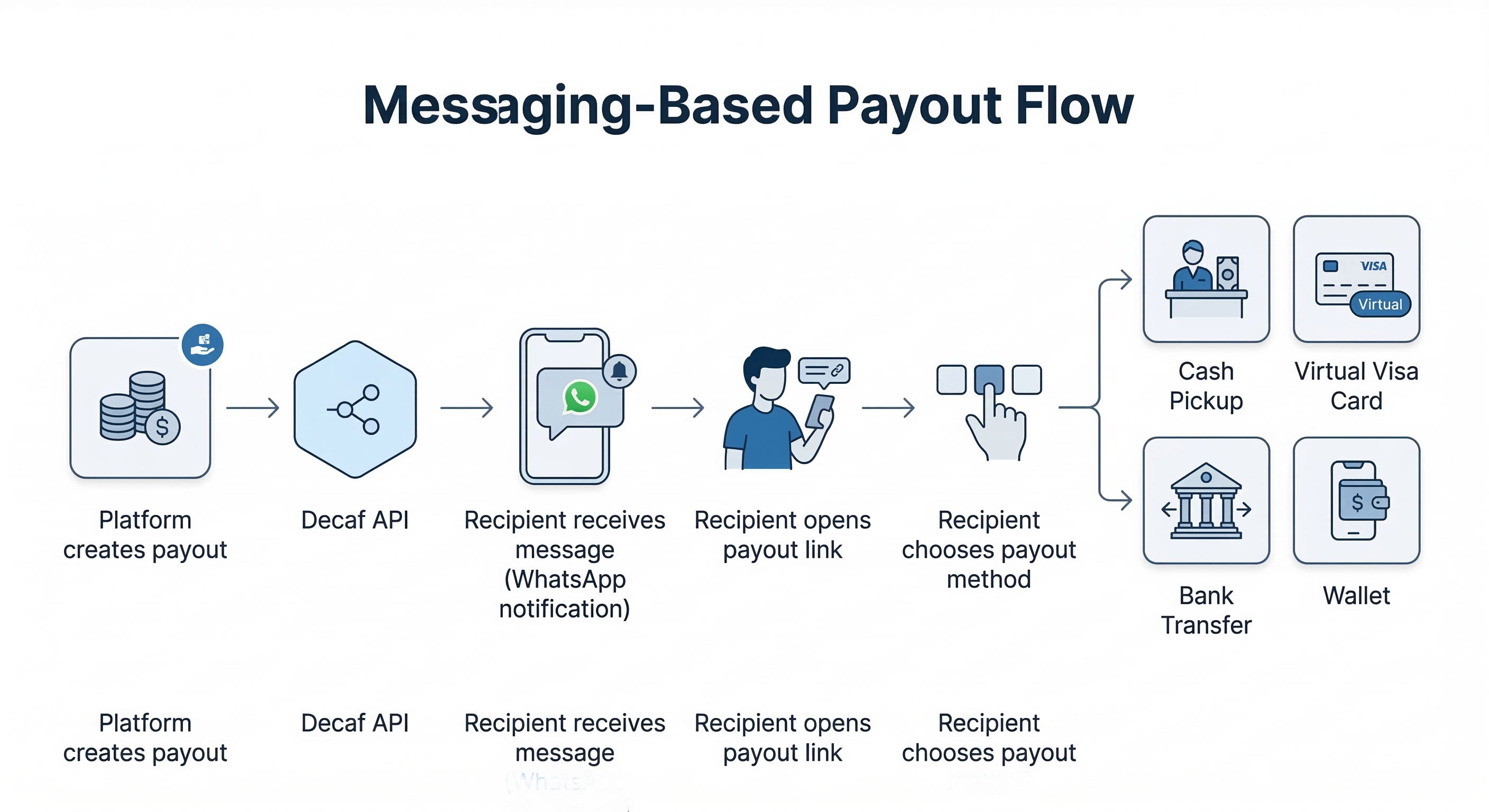
Many users interact with financial services through messaging platforms rather than traditional banking apps. Instead of requiring recipients to download a new application, Decaf delivers payout notifications directly through messaging channels such as:
• WhatsApp • email
Recipients receive a message that funds are available and complete a simple flow to withdraw their money. This dramatically reduces friction and improves accessibility.
Introducing the Decaf Developer Platform
To make it easier for companies to build global payment experiences, we recently launched the Decaf Developer Platform.
The platform includes:
• API documentation • integration guides • payout flow examples • webhook events • security best practices
Developers can integrate global payouts in just a few steps:
- Create recipient
- Create payout
- Notify recipient
- Receive webhook updates
Most integrations can send their first payout in minutes.
Explore the Developer Documentation
If you're building a platform that needs global payouts, remittances, or messaging-based payments, you can explore the Decaf developer documentation here:
https://www.decaf.so/en/developers
FAQ
What is a white-label remittance app?
A white-label remittance app is a financial platform that allows companies to offer international money transfers using prebuilt infrastructure. These systems still typically require regulatory compliance, banking integrations, and payout partners.
Is it difficult to build a remittance app?
Yes. Building a remittance platform requires licensing, compliance infrastructure, banking integrations, and payout networks. Many startups underestimate the operational complexity involved.
What is an alternative to building a remittance app?
Many companies integrate global payment infrastructure APIs instead. These platforms provide stablecoin settlement and global payout rails, allowing teams to add payments to their product without becoming financial institutions.
Final Thought
The internet has made products global by default. Financial infrastructure is still catching up.
Stablecoins, messaging platforms, and programmable APIs are reshaping how global payments are built. Decaf exists to provide the infrastructure that allows developers to build global financial products without having to build a remittance company first.