
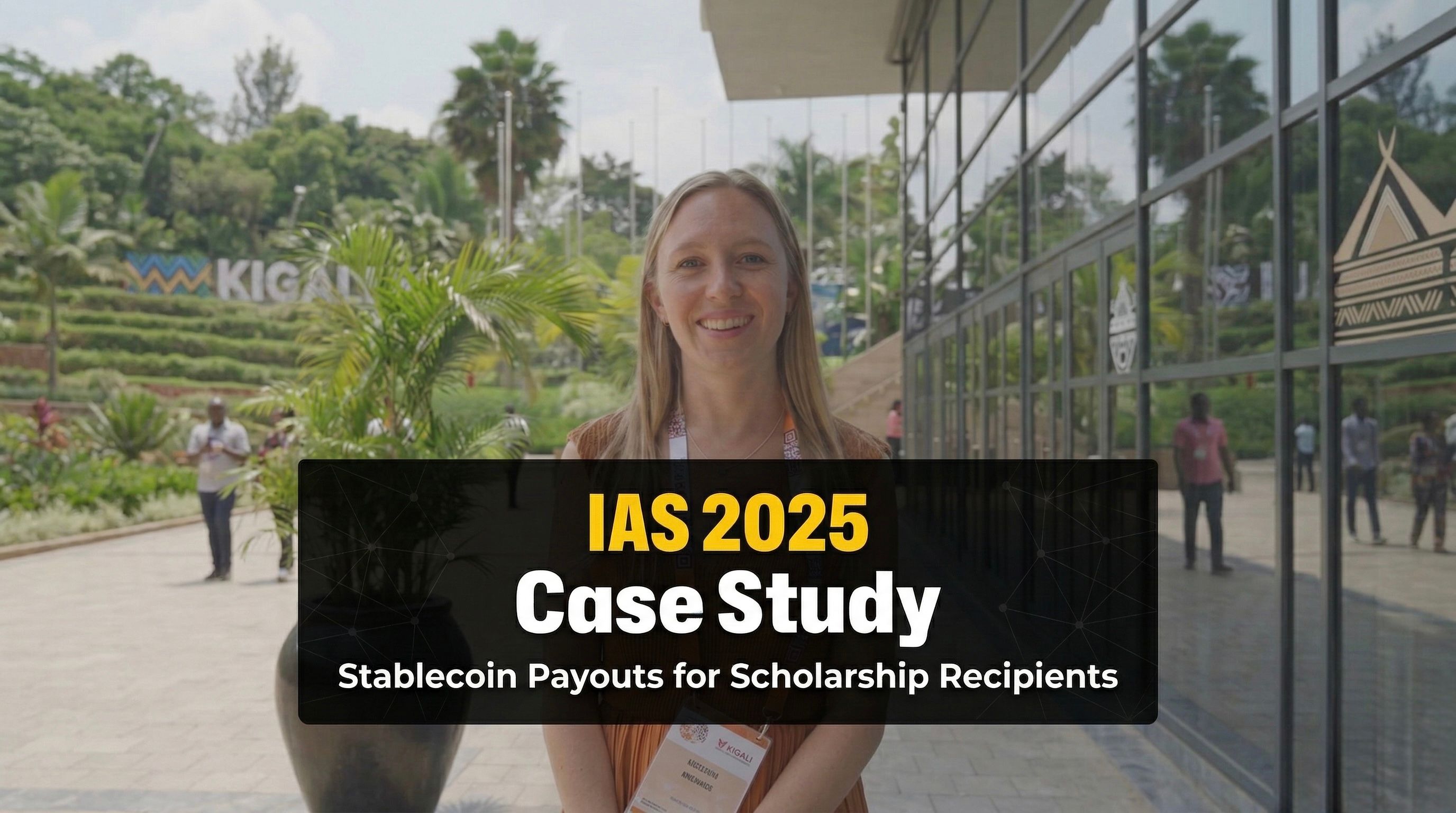
248 scholarship recipients · 50+ countries · 425 payments · 100% success rate
At the International AIDS Society (IAS) Conference 2025 in Kigali, Rwanda, organizers faced a familiar challenge shared by many global organizations: how to efficiently distribute funds to hundreds of international scholarship recipients.
Traditionally, this process relied on transporting large amounts of cash across borders, manually distributing envelopes, and managing long queues during the event.
In 2025, IAS decided to try a different approach.
By partnering with the Stellar Disbursement Platform (SDP) and Decaf Wallet, IAS replaced cash-based stipend distribution with USDC stablecoin payments, enabling secure digital disbursements to recipients from over 50 countries.
The results demonstrated how blockchain infrastructure can modernize global payments for conferences, NGOs, and humanitarian organizations.
The Challenge
Before adopting blockchain payments, IAS distributed stipends using a traditional cash-based process.
Staff members would withdraw large amounts of cash in Geneva, manually divide it into envelopes, and transport the funds internationally to the conference location. During the event, scholarship recipients would line up to collect their payments.
While effective in the past, this system created significant operational challenges.
Key challenges included:
Logistical complexity Transporting large amounts of cash internationally created administrative and security burdens for staff.
Long queues during the conference Recipients often spent hours waiting to collect stipends instead of participating in conference sessions.
Limited access to funds before travel Participants from many countries had no reliable way to receive funds ahead of the event.
Banking barriers Recipients from underbanked regions could not easily receive international bank transfers.
IAS needed a more efficient and scalable way to distribute funds globally.
The Solution
To modernize the process, IAS implemented a digital disbursement system powered by USDC stablecoins on the Stellar network.
The solution combined three components:
Stellar Disbursement Platform (SDP) A dashboard used by organizations to upload recipient lists and initiate bulk payments.
USDC stablecoins Digital dollars used as the payment asset for instant global transfers.
Decaf Wallet A mobile wallet that allowed recipients to receive, store, and withdraw their funds.
This infrastructure enabled IAS to distribute funds digitally without relying on cash or traditional banking systems.
How the System Worked
The new payment process was designed to be simple for both administrators and recipients.
Step 1: Organizational Setup
IAS onboarded with regulated USDC provider NOAH and completed KYB verification. After onboarding, the organization could fund disbursements through a standard bank transfer.
Step 2: Upload Recipient List
Conference organizers uploaded a spreadsheet containing recipient email addresses, stipend amounts, and a simple verification PIN into the Stellar Disbursement Platform dashboard.
Step 3: Automated Bulk Payments
With a single confirmation, the platform distributed 425 blockchain payments instantly while providing real-time status tracking for each disbursement.
Step 4: Recipients Claim Their Funds
Recipients received a secure email link allowing them to claim their payment. After downloading Decaf Wallet, verifying their identity, and entering their PIN, the USDC was delivered directly to their phone.
Step 5: Flexible Withdrawal Options
Recipients could then choose how to use their funds:
- Cash withdrawal via MoneyGram
- Transfer to a local bank account
- Spending with the Decaf Visa card
- Holding funds to withdraw later in their home country
This flexibility allowed participants from dozens of countries to access funds in the way that worked best for them.
Results
The transition from cash to stablecoin payments significantly improved both operational efficiency and recipient experience.
Payment Metrics
- 425 payments processed
- 233 unique recipients
- 50+ countries served
- Tens of thousands of USDC disbursed
- 0 failed transactions
The system delivered 100% payment success while eliminating the logistical complexity of cash distribution.
Operational Benefits
Eliminated Cash Logistics
IAS no longer needed to transport or manage large amounts of physical currency.
Reduced Administrative Overhead
Automated payments and real-time tracking significantly reduced staff workload.
Increased Transparency
Blockchain transactions provided clear payment records for donors, auditors, and internal teams.
Global Accessibility
Recipients from underbanked regions were able to receive funds directly on their phones.
Improved Recipient Experience
Participants could access their funds instantly without waiting in long queues.
As Martina, an IAS conference organizer, explained:
“We avoided long queues — those excruciating hours for both us and the scholarship recipients.”
Lessons Learned
For the IAS team, adopting stablecoin payments required learning a new technology. However, the transition proved far simpler than expected.
“I had no idea what stablecoins were before January 2025… but we appreciated the support from Decaf.”
By working with experienced partners and user-friendly tools, the team was able to implement the system quickly and successfully.
The result was not only operational efficiency, but also a better experience for scholarship recipients attending the conference.
Why This Matters for NGOs and Global Organizations
Many international organizations face similar challenges when distributing funds globally. Traditional financial systems often struggle with cross-border payments, particularly when recipients lack reliable banking access.
Stablecoins and blockchain infrastructure offer a new model for global disbursements.
Organizations can now:
- Deliver funds instantly across borders
- Track payments in real time
- Reduce fraud and operational risk
- Reach recipients without requiring bank accounts
For NGOs, humanitarian programs, and international conferences, this technology provides a scalable alternative to cash-based systems.
The Future of Global Aid Payments
The IAS Conference 2025 demonstrated how stablecoin payments can transform global disbursement programs.
By replacing envelopes of cash with secure digital payments, organizations can reduce operational complexity while improving accessibility and transparency.
As more organizations adopt this approach, stablecoins are emerging as a powerful tool for delivering financial support across borders.
Launch Stablecoin Disbursements for Your Organization
Decaf helps NGOs, humanitarian programs, governments, and global conferences distribute funds worldwide using stablecoins.
Our platform enables organizations to send payments instantly while providing recipients with flexible options for spending, cash withdrawal, or bank transfers.
👉 Learn more about Decaf Business: https://www.decaf.so/business